


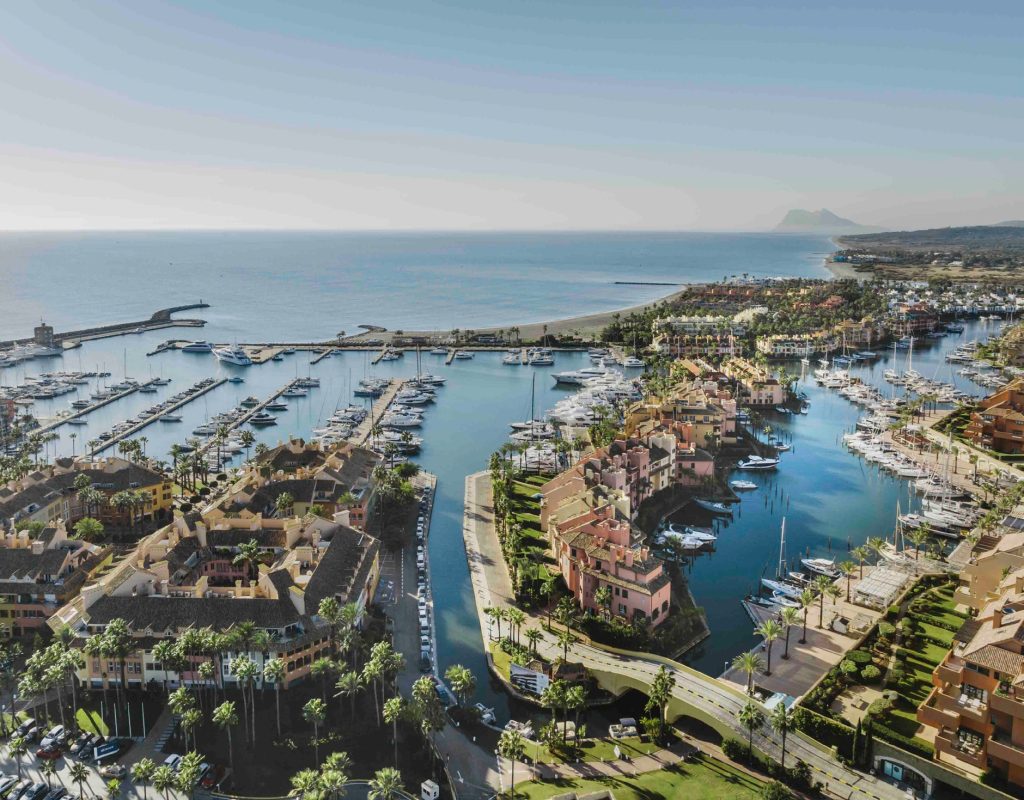
El mercado inmobiliario español se está enfriando ahora mismo: las ventas bajan, las hipotecas son más caras y los años de bonanza están llegando a su fin. Eso es así en casi todo el país. No es lo que está pasando aquí, en Sotogrande.
Aquí los precios acaban de marcar un nuevo récord. Las consultas aumentan. Los compradores siguen llegando con dinero en efectivo. Así que, antes de que esto se convierta en un aluvión de cifras, aquí va la versión corta: España se enfría, Sotogrande no, y los motivos dicen mucho sobre quién compra realmente aquí.
Qué está pasando en España, en términos sencillos
Pedir dinero prestado se ha encarecido este año. El Banco Central Europeo subió los tipos dos veces, en junio y en septiembre, y el índice que marca el coste de la mayoría de las hipotecas españolas —el Euríbor— alcanzó el 3,25% en septiembre, frente a aproximadamente el 2,17% de hace un año. Esto importa porque la mayoría de los compradores españoles necesitan una hipoteca.
El efecto se nota de inmediato en los datos. Los notarios registraron un 11% menos de compraventas de vivienda en julio respecto al año anterior, y el INE muestra una caída similar, tanto a nivel nacional como en Andalucía. Y sin embargo —esta es la parte que sorprende— los precios siguieron subiendo. El índice oficial de precios subió más de un 12% en el segundo trimestre, y el precio medio por metro cuadrado alcanzó un récord. España simplemente no tiene suficientes viviendas en venta (el Banco de España estima un déficit de unas 750.000), así que, incluso con menos compradores que pueden permitirse una hipoteca, los precios no han bajado.
Sotogrande no juega con las mismas reglas
Sotogrande funciona con un tipo de comprador distinto, y ahí está toda la clave. En nuestras propias transacciones de este año, el 82% de los compradores venían de fuera de España, y entre la mitad y las tres cuartas partes de las operaciones se cerraron sin hipoteca. Cuando sube el coste de pedir dinero prestado en España, apenas afecta a un mercado donde la mayoría paga al contado.
Eso se nota en las cifras. Los precios de salida en Sotogrande han subido un 11% en el último año, hasta una media de algo más de 4.000 €/m² —un récord para la zona, y aun así en torno a un tercio por debajo de lo que se paga en Marbella por una vivienda comparable. Las consultas y las ofertas en nuestra propia agencia también han aumentado respecto al año pasado.
Un breve recorrido por las zonas
No todas las zonas de Sotogrande se mueven igual:
| Área | Precio medio de salida | Variación en el último año |
|---|---|---|
| Puerto de Sotogrande y La Marina | ~4.375 €/m² | +22% |
| Sotogrande Costa | ~4.351 €/m² | +21% |
| Torreguadiaro y San Diego | ~4.309 €/m² | +12% |
| Sotogrande Alto, incluida La Reserva | ~4.077 €/m² | +7% |
La Marina ha sido la zona más activa este año: casi la mitad de nuestras ventas se cerraron allí. En Alto hubo menos operaciones, pero de mayor volumen. Algo que conviene saber: idealista contabiliza Alto y La Reserva como una sola zona en sus datos, aunque tienen precios muy distintos —las nuevas promociones de La Reserva se venden a precio de obra nueva, mientras que las viviendas de reventa más antiguas en el resto de Alto se venden por menos. Promediar ambas es la razón por la que el crecimiento de precios de esa zona parece menor de lo que realmente es, aunque las viviendas individuales, sobre todo en La Reserva, valen más que nunca.
Por qué está pasando esto
Tres factores explican casi todo. Primero, la mayoría de los compradores aquí no piden una hipoteca, así que los tipos de interés españoles apenas les afectan. Segundo, una libra más fuerte ha abaratado Sotogrande para los compradores británicos respecto a hace un año: una villa de 3 millones de euros le habría costado a un comprador británico al contado unas 62.000 libras más el año pasado que hoy, solo por el tipo de cambio. Tercero, la oferta educativa internacional, el golf y el estilo de vida que atrajeron a la gente aquí en primer lugar no han cambiado, y eso mantiene la demanda estable incluso cuando los titulares sobre el mercado español se vuelven negativos.
Nada de esto significa que Sotogrande sea inmune a todo. Es un mercado pequeño —unas 200 ventas al año—, así que un puñado de operaciones grandes puede mover las cifras mucho más de lo que lo haría en un mercado del tamaño de España. Parte de lo que parece un salto de precios es, en realidad, simplemente qué viviendas en concreto se vendieron en un trimestre dado, y no que cada vivienda haya pasado a valer más. Pero el patrón de fondo, ya durante varios trimestres seguidos, es consistente: la desaceleración de España es una historia de hipotecas, y en Sotogrande, en su mayoría, no se compra con hipoteca.
Qué significa esto si compras o vendes
Si vendes, este es un buen momento para hacerlo, sobre todo en la Marina y en la Costa, donde la demanda ha sido más fuerte. Dicho esto, un mercado fuerte sigue premiando poner el precio correcto desde el principio: las viviendas bien valoradas y bien presentadas son las que atraen el interés serio más rápido.
Si compras, no des por hecho que Sotogrande va a seguir la desaceleración general de España solo porque los titulares digan que el mercado se enfría: todavía no lo ha hecho, y los motivos van más allá de un bache pasajero. Lo que merece la pena vigilar, en cambio, es la próxima reunión del BCE el 29 de octubre, y cómo eso se traslada al mercado español en general en los próximos trimestres.
Como siempre, estos son los patrones que vemos en nuestras propias transacciones y en los datos publicados, no una garantía de cómo acabará una venta concreta: cada propiedad y cada negociación son distintas. Si quieres el panorama completo para tu caso, en Open Frontiers estamos encantados de comentarlo contigo.
Innin Buyl es Directora de Ventas en Open Frontiers, agente API/COAPI colegiada y con acreditación GIPE/CEPI. Open Frontiers ha sido nombrada Mejor Agencia Inmobiliaria de España por los International Property Awards en tres ocasiones —2023-24, 2024-25 y 2026-27— y es una agencia familiar, de segunda generación, con sede en Sotogrande, que lleva más de 30 años trabajando en el sector inmobiliario.
Spain’s housing market is cooling right now — sales are down, mortgages cost more, and the boom years are winding down. That’s true almost everywhere in the country. It just isn’t what’s happening here in Sotogrande.
Prices here just hit a new high. Enquiries are up. Buyers are still turning up with cash. So before this turns into a wall of numbers, here’s the short version: Spain is cooling, Sotogrande isn’t, and the reasons why say a lot about who actually buys here.
What’s happening to Spain, in plain terms
Borrowing got more expensive this year. The European Central Bank raised rates twice, in June and September, and the rate that sets most Spanish mortgage costs — Euribor — reached 3.25% in September, up from about 2.17% a year earlier. That matters because most Spanish buyers need a mortgage.
The effect shows up straight away in the data. Notaries recorded 11% fewer home sales in July than a year earlier, and Spain’s statistics office shows a similar drop, both nationally and in Andalucía. And yet — this is the part that surprises people — prices kept rising anyway. The official price index was up more than 12% in the second quarter, and the average price per square metre hit a record. Spain simply doesn’t have enough homes for sale (the Bank of Spain estimates a shortfall of roughly 750,000), so even with fewer buyers able to afford a mortgage, prices haven’t come down.
Sotogrande isn’t playing by the same rules
Sotogrande runs on a different kind of buyer, and that’s the whole story. In our own transactions this year, 82% of buyers came from outside Spain, and between half and three-quarters of all deals closed without a mortgage at all. When the cost of borrowing in Spain goes up, it barely touches a market where most people are paying cash.
That shows up in the numbers. Asking prices across Sotogrande have risen 11% over the past year, to an average of just over €4,000 per square metre — a record for the area, and still roughly a third below what buyers pay in Marbella for a comparable home. Enquiries and offers at our own agency are both up compared with last year.
A quick tour of the zones
Not every part of Sotogrande is moving the same way:
| Area | Average asking price | Change over the past year |
|---|---|---|
| Puerto de Sotogrande & La Marina | ~€4,375/m² | +22% |
| Sotogrande Costa | ~€4,351/m² | +21% |
| Torreguadiaro & San Diego | ~€4,309/m² | +12% |
| Sotogrande Alto, including La Reserva | ~€4,077/m² | +7% |
Source: idealista asking-price data, year to date.
The Marina has been the busiest part of the market this year — almost half of our sales happened there. Alto saw fewer sales, but bigger ones. One thing worth knowing: idealista counts Alto and La Reserva as a single zone in its data, even though they’re priced very differently — La Reserva’s new-build launches sell at new-build prices, while older resale homes elsewhere in Alto go for less. Averaging the two together is why that zone’s price growth looks smaller than it really is, even though individual homes, especially in La Reserva, are worth more than ever.
Why this is happening
Three things are doing most of the work. First, most buyers here aren’t taking out a mortgage at all, so Spanish interest rates barely touch them. Second, a stronger pound has quietly made Sotogrande cheaper for British buyers than it was a year ago — a villa priced at €3 million would have cost a UK cash buyer roughly £62,000 more last year than it does today, purely because of the exchange rate. Third, the international schooling, the golf, and the lifestyle that drew people here in the first place haven’t changed, and that keeps demand steady even when headlines about Spain’s market turn negative.
None of this means Sotogrande is immune to everything. It’s a small market — around 200 sales a year — so a handful of large deals can swing the numbers much more than they would in a market the size of Spain’s. Some of what looks like a price jump is really just which particular homes happened to sell in a given quarter, rather than every home becoming worth more. But the underlying pattern, now several quarters running, is consistent: Spain’s slowdown is a mortgage story, and Sotogrande mostly isn’t buying on a mortgage.
What it means if you’re buying or selling
If you’re selling, this is a good market to be doing it in, particularly in the Marina and along the Costa, where demand has been strongest. That said, a strong market still rewards getting the price right from the start — well-priced, well-presented homes are the ones attracting serious interest fastest.
If you’re buying, don’t assume Sotogrande will follow Spain’s broader slowdown just because the headlines say the market is cooling — it hasn’t yet, and the reasons run deeper than a temporary blip. What’s worth watching instead is the ECB’s next meeting on 29 October, and how that filters through to the wider Spanish market over the following quarters.
As always, these are the patterns we see in our own transactions and in the published data, not a guarantee of where any individual sale will land — every property and every negotiation is different. If you’d like the fuller picture for your own situation, Open Frontiers is always happy to talk it through.
Innin Buyl is Director of Sales at Open Frontiers, a licensed API/COAPI real estate professional with GIPE/CEPI accreditation. Open Frontiers has been named Best Real Estate Agency in Spain by the International Property Awards three times — 2023–24, 2024–25 and 2026–27 — and is a second-generation, family-run agency based in Sotogrande that has worked in real estate for more than 30 years.


