





El director general de Arcgisa nos confirma en esta entrevista el fin de las medidas de ahorro por la sequía, tras un invierno lluvioso en el que los embalses de la comarca han recuperado gran parte de su capacidad
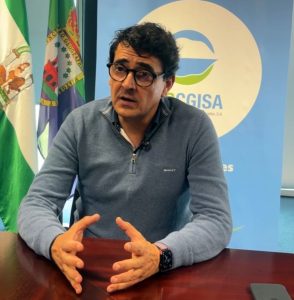
José Manuel Alcántara, director general de Arcgisa, nos recibe en la sede de la empresa comarcal de agua y residuos para analizar la situación hídrica en el Campo de Gibraltar tras las últimas lluvias de febrero y marzo.
Muchas gracias por la entrevista, José Manuel. Entiendo que, como director de Arcgisa, estarás mucho más tranquilo con las lluvias del último mes…
Sin duda. Las lluvias de esta sucesión de borrascas nos salvan de la situación de sequía permanente que veníamos sufriendo. Llevábamos seis años con precipitaciones por debajo de la media, la sequía más larga que recordamos en la zona, pero en este invierno, como hace años, han vuelto una serie de borrascas sucesivas con quince días de lluvias continuas. Y como el suelo ya estaba con un nivel de saturación adecuado, los embalses han cogido un volumen importante. Si hay más precipitaciones de aquí al verano, es posible que incluso tengamos que aliviar parte de los embalses, lo que sería una grata noticia.
Entonces, ¿con estas lluvias se acabarán las restricciones?
Por descontado. Aún hay varias actuaciones administrativas para hacerlo oficial, como la reunión del comité de sequía de la cuenca y la mesa comarcal, pero este verano ya es prácticamente seguro que no va a haber restricciones.
Esas restricciones causaron mucho malestar en Sotogrande, donde se consideraba que el suministro de agua era insuficiente
Me parece un planteamiento absolutamente injusto. No hay zona donde se haya sido más generoso a nivel comarcal que con Sotogrande, porque su tipología urbana induce a grandes consumos de agua. Con tantos jardines y piscinas, su consumo por habitante es cuatro o cinco veces mayor que en el resto de la comarca. Además, los cálculos dotacionales los hacíamos con la población real, no por el censo. Se calculaba en base a la generación diaria de residuos, mediante el que sabemos la población que hay en cada momento.
Por eso no considero justo ese planteamiento, más bien es todo lo contrario. Toda la comarca ha sido solidaria con Sotogrande porque somos conscientes que es una zona importante para el campo de Gibraltar que genera una gran actividad económica. Y por tanto, igual que se cuida la industria o el sector agrícola, también hay que cuidar Sotogrande, y afortunadamente se ha gestionado de manera muy adecuada.
Hemos tenido la peor sequía que recordamos y a pesar de ello, el impacto fueron algunas restricciones al riego, piscinas y poco más, pero la gente, en general, pudo seguir con su vida normal. Honestamente creo que la gestión de esta sequía ha sido altamente eficaz, y también hemos aprendido varias lecciones para la próxima, que llegará.
Para Sotogrande además, hay un proyecto muy importante a punto de iniciarse, el suministro de agua regenerada para todos esos consumos como el riego de jardines. Esto convertirá a Sotogrande en la urbanización más sostenible de Europa, posiblemente.
Hablando del futuro, son muy importantes inversiones como la recientemente inaugurada entre Castellar y Guadiaro
Esta nueva conducción (ver página 28 de esta edición) también es fundamental para Sotogrande y el Valle del Guadiaro, porque nos permitirá suministrar con garantía de recursos a toda la zona, sin las limitaciones del antiguo sistema desde los embalses.
Pero también servirá para trasvasar agua a la Costa del Sol…
Sí, pero sólo siempre y cuando el Campo de Gibraltar tenga garantizado los dos años de consumo. Es un acuerdo solidario que tenemos con la Costa del Sol pero que nunca perjudica a nuestra comarca, porque sólo se trasvasa el agua sobrante. De hecho, durante estos años de sequía no se ha hecho ningún trasvase porque estas condiciones no se cumplían.
Muchas gracias por atendernos e informarnos, José Manuel.
_____________________________
José Manuel Alcántara: “With the latest rainfall, we can rule out further restrictions for next summer”
 Arcgisa’s general manager confirms in this interview the end of the drought saving measures, after a rainy winter in which the region’s reservoirs have recovered a large part of their capacity.
José Manuel Alcántara, general manager of Arcgisa, welcomes us to the headquarters of the regional water and waste company to analyse the water situation in Campo de Gibraltar following the latest rainfall of February and March.
Thank you very much for this interview, José Manuel. I understand that, as director of Arcgisa, you are much calmer after the rainfall of the last month?
Undoubtedly. The rains from this succession of squalls have saved us from the permanent drought conditions we had been suffering. For six years we have had below-average rainfall, the longest drought we can remember in the area, but this winter, as in years past, a series of successive squalls have brought back a fortnight of continuous rain. Since the soil was already at an adequate level of saturation, the reservoirs have taken on a significant volume. If there is more rainfall between now and the summer, we may even have to relieve some of the reservoirs, which would be welcome news.
Does this rain mean the restrictions will be lifted?
Of course. There are still several administrative actions to make it official, such as the meeting of the basin’s drought committee and the regional round table, but it is practically certain that there will be no restrictions at all this summer.
These restrictions caused much unrest in Sotogrande, where the water supply was considered insufficient.
It seems to me to be an absolutely unfair approach. There is no area that has been more generous at a regional level than Sotogrande, because its urban typology leads to high water consumption. With so many gardens and swimming pools, its consumption per inhabitant is four or five times higher than in the rest of the region. In addition, we used to calculate the water allocation based on the real population, not on the census. It was calculated on the basis of the daily generation of waste, by means of which we knew the population present at any given moment.
That’s why I don’t consider this approach to be fair, quite the opposite. The whole region has shown solidarity with Sotogrande because we are aware that it is an important area for the Campo de Gibraltar and that it generates a great deal of economic activity. Therefore, just as we take care of the industry or the agricultural sector, we also have to take care of Sotogrande, and fortunately it has been managed very well.
We have had the worst drought in living memory and despite this, the impact was a few restrictions on irrigation, swimming pools and little else, but people, in general, were able to carry on with their normal lives. I honestly believe that the management of this drought has been highly effective, and we have also learned several lessons for the next one, which will certainly come.
Furthermore, there is a very important project about to start in Sotogrande, the supply of reclaimed water for all such uses as garden irrigation. This will possibly make Sotogrande the most sustainable urbanisation in Europe.
As for the future, there are very important investments such as the one recently completed between Castellar and Guadiaro.
This new pipeline (see page 28 of this edition) is also fundamental for Sotogrande and the Guadiaro Valley, because it will allow us to supply the whole area with a guaranteed supply of resources, without the limitations of the old system via the reservoirs.
Yet it will also be used to divert water to the Costa del Sol…
Yes, but only as long as the Campo de Gibraltar has two years of guaranteed consumption. It is a solidarity agreement that we have with the Costa del Sol but which will never harm our region, because only surplus water is transferred. In fact, during these years of drought, no water transfers have been made because these conditions were not met.
Thank you very much for your attention and for keeping us informed, José Manuel.