

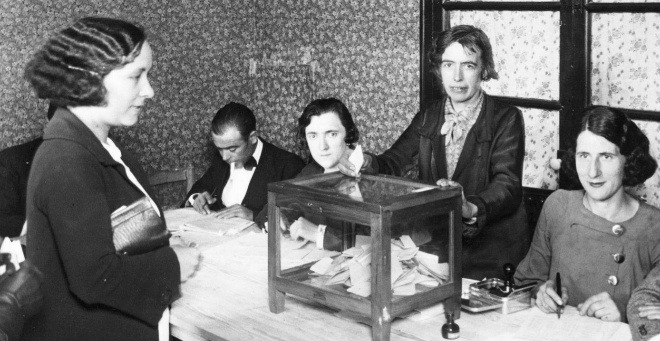
El próximo 23 de abril se cumplen 91 años de las elecciones municipales de 1933, las primeras en las que la mujer pudo votar en España
El voto femenino es uno de los principales indicadores de que una sociedad logra alcanzar un verdadero sistema democrático donde cada ciudadano, sin importar su género, cuenta con el mismo derecho al voto que el resto.
Durante la mayor parte de la Historia, independientemente de la civilización y cultura que señalemos, las mujeres fueron constantemente excluidas de este derecho. En las primeras sociedades que practicaron una inicial democracia, como las polis griegas, únicamente votaban los hombres adultos y libres (excluyendo a mujeres, niños y esclavos). Y ni siquiera tras los movimientos revolucionarios liberales del siglo XVIII, que acabaron con el Antiguo Régimen en Europa, la idea de ciudadano libre independientemente de su estamento social y con derecho a elección de sus representantes políticos, incluía a las mujeres.
Por eso a finales del siglo XIX tanto en Europa como en Norteamérica los movimientos sufragistas femeninos comenzaron a reclamar una verdadera igualdad de derechos civiles y políticos, enfrentándose a barreras sociales, culturales y religiosas en esas democracias que sólo lo eran verdaderamente para la población masculina.
Los primeros movimientos por el sufragio femenino en España también tienen sus raíces en esa época, aunque no fue hasta ya entrado el siglo XX cuando estas demandas comenzaron a ganar terreno, impulsadas por el creciente activismo de las mujeres y los cambios políticos y sociales en Europa y el mundo.
La proclamación de la Segunda República en abril de 1931 dio esperanzas a los movimientos sufragistas de conseguir por primera vez el derecho al voto para todas las mujeres en España. Sin embargo, la cuestión siguió marcada por constantes debates en todo el espectro político, donde a la férrea oposición de la gran mayoría del sector conservador, se unía una fuerte discrepancia dentro de la propia izquierda.
 Una de las figuras clave en ese periodo fue Clara Campoamor, una destacada política que desempeñó un papel fundamental en la redacción de la primera Constitución de la Segunda República, que ya otorgaba a las mujeres el derecho al voto. En contra de la posición liderada por Campoamor, otra parlamentaria como Victoria Kent, miembro del Partido Republicano Radical Socialista, y varios dirigentes del PSOE como Indalecio Prieto, plantearon reparos considerando aún escasa la preparación de las mujeres para ejercer el derecho al voto por sí misma de manera informada y responsable.
Kent y Campoamor, dos de las tres únicas diputadas en ese Congreso, compartían un compromiso profundo con la igualdad de derechos de las mujeres, con lo que el choque entre ambas parlamentarias en el caso del voto fue especialmente simbólico. Mientras que la malagueña apostaba por aplazar la cuestión, Campoamor defendió con firmeza su aprobación inmediata, señalando el voto femenino como un principio fundamental en una sociedad verdaderamente democrática y justa.
Finalmente, el 1 de octubre de 1931, las Cortes aprobaron su inclusión en la nueva Constitución con 161 votos a favor y 122 en contra. El intenso debate entre las fuerzas de la izquierda provocó que, si bien la mitad de los votos favorables procedieron de parlamentarios socialistas, otro destacado grupo de ellos optó por la abstención, entre ellos el ya mencionado Prieto, ministro de Hacienda, y Julián Besteiro, presidente de la Cámara.
Una vez aprobado definitivamente, la primera ocasión en la que las mujeres españolas pudieron ejercer su nuevo derecho llegaría en 1933, con las elecciones municipales del 23 de abril y las generales de noviembre. Tras la dictadura franquista, desde el inicio de la restauración de la democracia con la Transición a mediados de los 70, el voto femenino no volvió a cuestionarse en ningún momento, consolidándose definitivamente hasta hoy como un derecho inalienable para la mujer en España.
_________________________________
Women’s suffrage in Spain: a historic milestone for equality in our country, still less than a century old
This 23rd of April marks the 91st anniversary of the 1933 municipal elections, the first in which women in Spain were allowed to vote
Women’s suffrage is one of the main indicators that a society succeeds in achieving a true democratic system where every citizen, regardless of gender, has the same right to vote as everyone else.
For most of history, whatever civilisation and culture we point to, women were consistently excluded from this right. In the first societies that practised early democracy, such as the Greek polis, only free adult men (excluding women, children and slaves) voted. Nor, even after the liberal revolutionary movements of the 18th century, which put an end to the Old Regime in Europe, did the idea of free citizens, regardless of their social status and with the right to elect their political representatives, include women.
That is why at the end of the 19th century in both Europe and North America women’s suffragette movements began to demand true equality of civil and political rights. Women faced social, cultural and religious barriers in these democracies, which were only truly equal for the male population. The first movements for women’s suffrage in Spain also trace their roots to this period, although it was not until well into the 20th century that these demands began to gain ground, driven by the growing activism of women and the political and social changes in Europe and the world.
The proclamation of the Second Republic in April of 1931 brought hope to the suffragette movements in order to achieve for the first time the right to vote for all women in Spain. However, the issue continued under constant debate across the political spectrum, where the fierce opposition of the vast majority of the conservative sector was joined by strong disagreement within the left itself.
One of the key figures in this period was Clara Campoamor, a prominent politician who was instrumental in the drafting of the first Constitution of the Second Republic, which already granted women the right to vote. Contrary to the position led by Campoamor, another parliamentarian, Victoria Kent, a member of the Socialist Radical Republican Party, and several leaders of the PSOE, such as Indalecio Prieto, raised objections. They considered that women were still poorly prepared to exercise the right to vote for themselves in an informed and responsible manner.
Kent and Campoamor, two of only three female deputies in that Congress, shared a deep commitment to equal rights for women, making the clash between
the two parliamentarians in the case of the vote particularly symbolic. While the Malaga-born woman was in favour of postponing the issue, Campoamor firmly defended its immediate approval, pointing to women’s suffrage as a fundamental principle in a truly democratic and just society.
Finally, on the 1st of October of 1931, the Parliament approved its inclusion in the new Constitution with 161 votes in favour and 122 against. The intense debate among the forces of the left meant that, although half of the votes in favour came from socialist parliamentarians, another prominent group of them chose to abstain, among them the aforementioned Prieto, Minister of Finance, and Julián Besteiro, President of the Chamber.
Once it was fully approved, the first chance for Spanish women to exercise their new right came in 1933, during the municipal elections of the 23rd of April and the general elections held that November. Following Franco’s dictatorship, since the beginning of the return to democracy with the Transition period in the
mid-1970s, women’s suffrage has never again been questioned, and has been firmly consolidated to this day as an inalienable.