




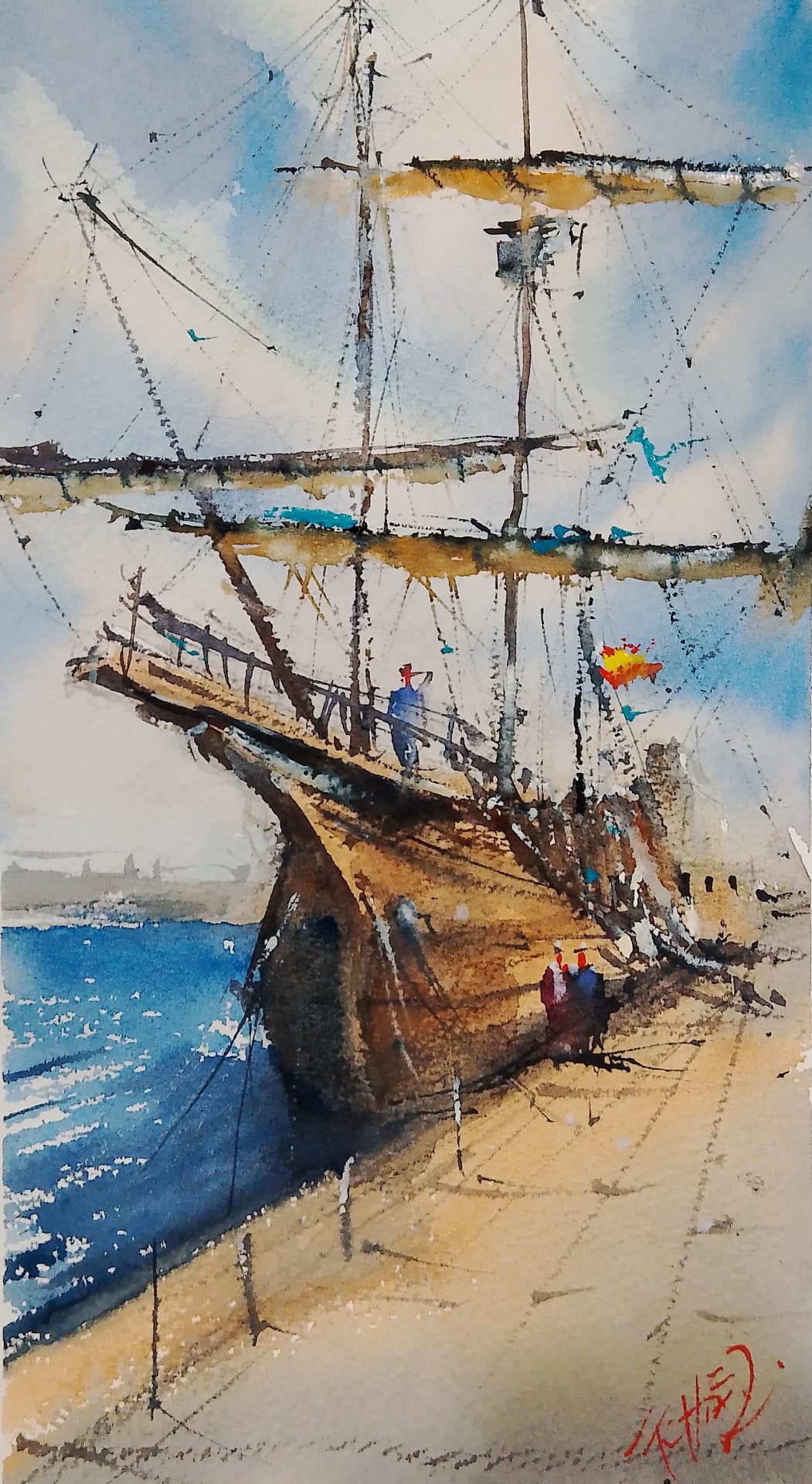
La nueva obra de Paco Hernández nos muestra una de las visitas más especiales a Puerto Sotogrande, el atraque de la Nao Victoria, la fiel réplica de la embarcación que completó la primera vuelta al mundo
Dentro de su estrecha relación con la navegación, Sotogrande y su puerto deportivo no sólo acoge a espectaculares embarcaciones deportivas y de recreo, sino que, ocasionalmente, también recibe auténticas bellezas del patrimonio marítimo.
Entre ellas destaca la Nao Victoria, réplica del barco que protagonizó con Fernando de Magallanes y Juan Sebastián Elcano la primera vuelta al mundo. Sus escalas en Puerto Sotogrande siempre generan interés entre vecinos y visitantes, que aprovechan la oportunidad para visitar una nave cargada de simbolismo, a la que tampoco se ha podido resistir nuestro acuarelista.
La acuarela
Paco Hernández nos presenta una visión muy personal de la Nao Victoria, centrando la composición en la imponente presencia del casco y el complejo entramado de mástiles, palos y cabos que dibujan la silueta de esta embarcación histórica.
El artista juega con una combinación de tonos azules y ocres que enfrentan el mar y la madera, destacando el contraste entre la frialdad del agua y la calidez del casco envejecido. La pincelada rápida y expresiva aporta dinamismo y refleja la imponente presencia de una embarcación que, además de su valor histórico, refleja fielmente el espíritu aventurero que convirtió su nombre y el de sus tripulantes en leyenda.
Impresiones del artista
La Fundación Nao Victoria es una visitante habitual de Puerto Sotogrande. No podía dejar pasar la oportunidad de pintar una de esas visitas tan especiales. La *Nao Victoria, junto a su barco hermano, el **Galeón Andalucía*, recala con frecuencia en nuestro puerto y siempre despierta admiración.
Planto el caballete frente a ella y, mientras preparo la acuarela, cientos de pensamientos cruzan por mi cabeza. Me encuentro cara a cara con la primera embarcación que consiguió dar la vuelta al mundo, o mejor dicho, con una réplica exacta de aquella nave que cambió para siempre la historia de la navegación.
Pienso en aquella expedición capitaneada por Fernando de Magallanes. Doscientos treinta y nueve hombres partieron rumbo a lo desconocido, impulsados por la incertidumbre, la ambición y el deseo de descubrir nuevos horizontes. Solo dieciocho regresarían a España, entre ellos Juan Sebastián Elcano, quien tomó el mando de la expedición tras la muerte de Magallanes y logró culminar una de las mayores gestas de la humanidad.
Siempre me ocurre lo mismo cuando pinto. Entro en un estado de concentración en el que la mente parece divagar libremente. Mientras la mano trabaja casi por instinto, los pensamientos viajan muy lejos. Sin embargo, en esta ocasión solo había una idea ocupando mi cabeza: ¿qué clase de hombres eran aquellos capaces de enfrentarse a una aventura de semejante magnitud?
La acuarela surge con soltura y dinamismo. Los azules intensos del cielo contrastan con la calidez de las maderas envejecidas del casco. Introduzco un grafismo muy marcado para sugerir el complejo entramado de cabos, escotas y drizas que caracteriza a este tipo de embarcaciones, buscando transmitir tanto su belleza como su extraordinaria complejidad.
Quedo satisfecho con el resultado, pero al guardar los pinceles sigo pensando en aquellos marineros. En su valentía, en su espíritu aventurero y en las enormes penurias que debieron soportar durante tres años de navegación en una nave como la que tengo ahora mismo delante de mis ojos. Quizá esa sea la verdadera magia de la acuarela: no solo pintar un barco, sino intentar captar la historia que aún parece respirar entre sus maderas.
____________________________________
Sotogrande in watercolours: the Nao Victoria drops anchor in Puerto Sotogrande
Paco Hernández’s latest piece captures one of the most remarkable visits to Puerto Sotogrande: the docking of the Nao Victoria, a faithful replica of the first vessel to ever circumnavigate the globe.
Deeply rooted in maritime tradition, Sotogrande and its marina do not just play host to spectacular sports and leisure yachts; occasionally, they welcome true gems of seafaring heritage.
Chief among them is the Nao Victoria, a replica of the ship that made history under the command of Ferdinand Magellan and Juan Sebastián Elcano during the first voyage around the world. Its stopovers at Puerto Sotogrande never fail to draw crowds of locals and visitors alike, all eager to step aboard a vessel steeped in symbolism—an allure that our resident watercolourist simply could not resist.
The Artwork
Paco Hernández offers a deeply personal vision of the Nao Victoria, centering his composition on the imposing presence of the hull and the intricate rigging of masts, spars, and ropes that define the silhouette of this historic ship.
The artist plays with a palette of blues and ochres, contrasting the sea against the timber—juxtaposing the coldness of the water with the warmth of the weathered hull. His swift, expressive brushstrokes inject dynamism into the piece, capturing not only the commanding presence of a ship of immense historical value, but also the adventurous spirit that turned its name and its crew into legend.
In the Artist’s Words
«The Nao Victoria Foundation is a regular visitor to Puerto Sotogrande, and I couldn’t miss the opportunity to paint one of these very special visits. The Nao Victoria, along with its sister ship, the Galeón Andalucía, frequently calls at our port, always drawing widespread admiration.
I set up my easel right in front of her, and as I mix my watercolours, hundreds of thoughts race through my mind. I find myself face-to-face with the first vessel to sail around the world—or rather, an exact replica of that legendary ship that changed the history of navigation forever.
My mind drifts to that expedition led by Ferdinand Magellan. Two hundred and thirty-nine men set sail into the unknown, driven by uncertainty, ambition, and a burning desire to discover new horizons. Only eighteen would return to Spain, among them Juan Sebastián Elcano, who took command of the expedition after Magellan’s death and successfully completed one of humanity’s greatest feats.
The same thing always happens to me when I paint. I fall into a state of deep concentration where my mind seems to wander freely. While my hand works almost instinctively, my thoughts travel far away. However, this time, a single question kept echoing in my mind: what kind of men were they, to face an adventure of such staggering magnitude?«
«The watercolour comes together with ease and dynamism. The intense blues of the sky strike a sharp contrast against the warmth of the hull’s weathered timber. I introduce bold, distinct linework to suggest the complex rigging of lines, sheets, and halyards so characteristic of these vessels, aiming to capture both its beauty and its extraordinary complexity.
I am pleased with the result, yet as I pack away my brushes, my thoughts linger on those sailors—on their courage, their adventurous spirit, and the staggering hardships they must have endured during three years at sea aboard a ship just like the one standing before me now. Perhaps that is the true magic of watercolours: it is not merely about painting a ship, but about trying to capture the history that still seems to breathe within its timber.»