




Artistas y promotores culturales coinciden en que Sotogrande cuenta con talento, público e iniciativas para convertirse en una zona de referencia, pero aún necesita consolidar una verdadera oferta cultural durante todo el año
Salvador Puerto
Sotogrande tiene deporte, gastronomía, naturaleza, turismo y una comunidad internacional cada vez más asentada durante todo el año. También tiene artistas. Pintores, escultores, músicos y creadores, en definitiva, llegados de distintos países que desarrollan aquí su trabajo, además de iniciativas privadas que han ido abriendo pequeños espacios para que el arte encuentre un lugar entre restaurantes, galerías y otros escenarios. Lo que parece faltar es una estructura capaz de unir todas esas piezas.
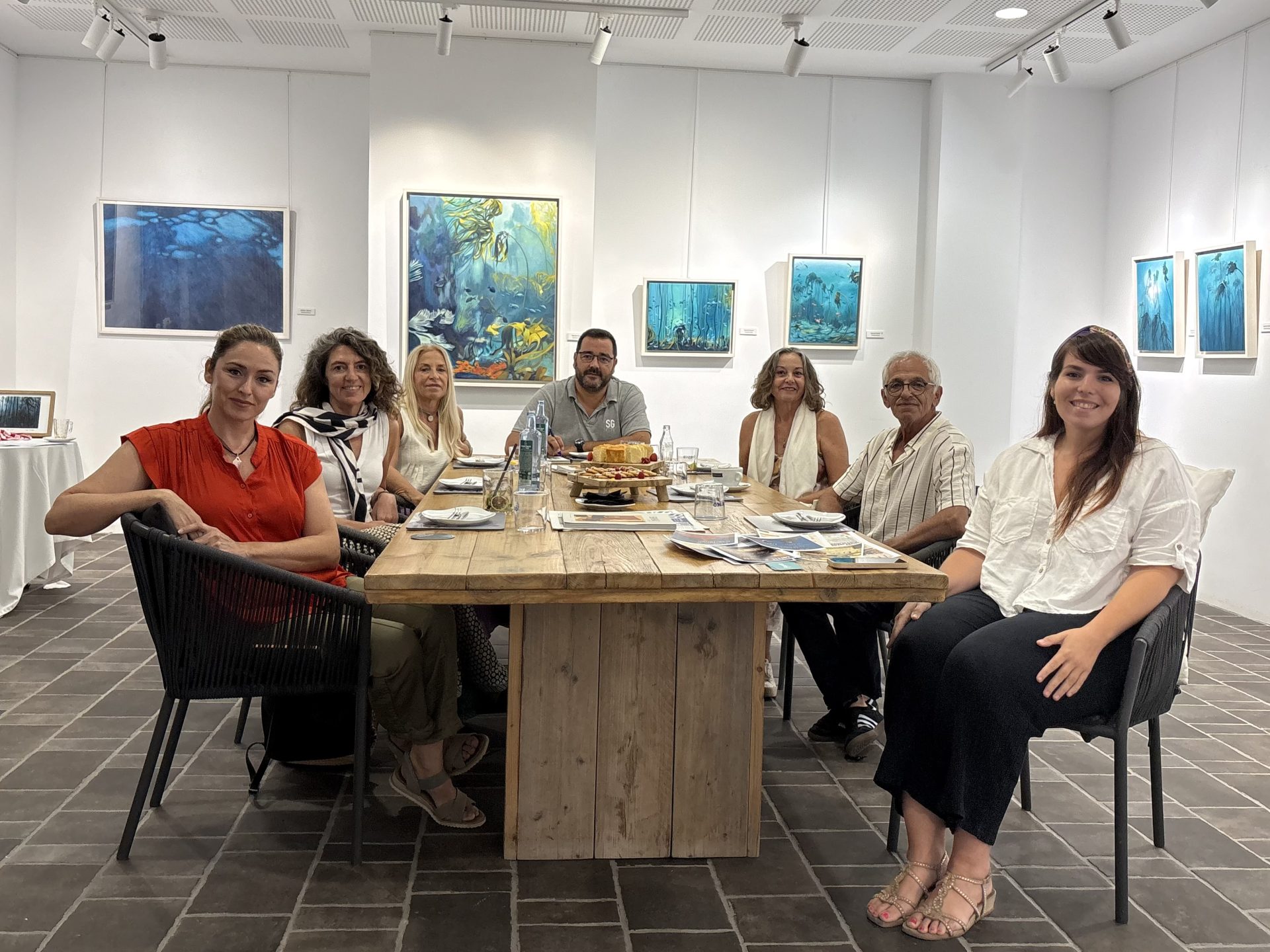
Esa fue una de las principales conclusiones del nuevo encuentro de SGplus, celebrado en Fresco Marina, precisamente uno de los espacios que mejor ejemplifica ese crecimiento. Carmen Jiménez, artista, promotora cultural y presidenta de la Asociación Cultural Mosayko; Osvaldo Lobalzo, pintor y escultor argentino afincado en Sotogrande; Syrie Jo Blanco Walsh, artista y propietaria de La FincaThai Fusion; María García, responsable de marketing y eventos de Fresco Marina; y Ana Martínez, artista cordobesa que durante septiembre expone allí su colección Kelp Forest, compartieron experiencias, propuestas y también algunas de las dificultades que encuentran quienes intentan hacer del arte algo más habitual en la vida de Sotogrande.
Porque la primera constatación es que, más allá de sus reconocidos atractivos, en Sotogrande también existe un verdadero interés por el arte. Ana Martínez lo ha comprobado directamente desde que llegó con su exposición. Tras mostrar su trabajo en Córdoba, Sevilla o Málaga, se ha encontrado aquí con un público especialmente internacional. «Es como ir a una feria internacional de arte, con gente muy diversa que visita tu exposición, que se interesa y te pregunta. Es una experiencia muy enriquecedora a nivel de feedback», explica, poniendo como anécdota un visitante japonés que reconoció en sus obras referencias a peces propios de su país.
 Para Osvaldo Lobalzo, esa dimensión internacional es uno de los grandes valores de Sotogrande: “Aquí hay interés por el arte sobre todo por los ciudadanos extranjeros que deciden vivir aquí. Admiran el arte, saben apreciarlo, y compran obras para sus casas. Para ellos no es un pasatiempo nada más. A veces quieren tener más información y eso para el artista es muy enriquecedor», explica.
El problema, por tanto, no parece estar en la ausencia de artistas ni en la inexistencia de público. Está, según nos aseguran nuestros invitados a lo largo del coloquio, en la falta de espacios y de continuidad, entre otros motivos. Sotogrande ha tenido históricamente iniciativas puntuales, estudios, galerías y exposiciones, pero sigue sin disponer de un lugar cultural de referencia donde puedan convivir disciplinas diferentes. Un espacio multiusos donde realizar exposiciones, talleres, conciertos, presentaciones literarias, poesía o pequeñas representaciones teatrales.
Lobalzo lo resume con una frase que durante el encuentro termina adquiriendo casi la condición de lema: “Sotogrande lo tiene todo, pero le falta arte”. Él conoce además de primera mano las posibilidades que puede generar un espacio de estas características, recordando durante el coloquio el estudio y galería que mantuvo precisamente donde hoy se erige Fresco, y donde organizaba conciertos y talleres con mucho éxito. “Nos llegaba público local pero también de Marbella, San Pedro o Estepona, hasta el punto de dejar a personas fuera por falta de espacio. El proyecto acabó siendo inviable después de un fuerte incremento del alquiler del local”.
“Contar con más colaboración sería fundamental», insiste Lobalzo cuando se plantea qué necesitaría Sotogrande para dar un salto en materia artística. No habla únicamente de instituciones. También de empresas, establecimientos y profesionales que sean capaces de entender que una programación cultural puede beneficiar al conjunto y no únicamente a quien la organiza.
“Lamentablemente es muy difícil poner de acuerdo a los comerciantes locales”, coincide Carmen Jiménez desde su experiencia con Mosayko, cuyos eventos parten de la combinación de disciplinas y de la utilización de espacios exteriores.
Fresco Marina con su salón reconvertido en galería es, en ese sentido, una de las excepciones en positivo más destacadas. Al igual que el apoyo a la cultura que manifiesta Puerto Sotogrande con múltiples iniciativas, tal y como confirman Osvaldo y Carmen, que por otro lado echan de menos la colaboración de otras instituciones y entidades locales de Sotogrande y San Roque.
Por parte de Fresco, María García explica que la evolución de la galería ha sido muy rápida. “Cada vez más creadores nos contactan interesándose por exponer con nosotros. Desde mayo ya tenemos la galería completa todo el año y ya hay bastantes peticiones para 2027», señala.
Syrie aporta otro factor para el éxito de la pequeña galería de Fresco, alabando la gestión de María por su exitosa selección de artistas y proyectos. “No se trata únicamente de llenar espacios, sino de construir una programación con identidad, y para ello es fundamental la calidad de lo que se presenta”, sostiene.
Durante el encuentro, se ponen sobre la mesa diferentes propuestas que bien podrían realizarse en Sotogrande, como integrar el arte en del propio paisaje urbano local. En este sentido, Ana Martínez pone a Genalguacil, que desde hace años adorna sus calles con obras que se crean en su encuentro internacional de artistas, como ejemplo de cómo el arte puede enriquecer la imagen de una localidad. Por ello se plantea qué podría ocurrir si las intervenciones artísticas formaran parte de la vida cotidiana de Sotogrande: “con calles, espacios públicos, establecimientos y rincones convertidos en escenarios de creación. Que todo se convirtiese en arte vivo”.
También se habla de, con los apoyos necesarios, la posibilidad de crear eventos como una Semana del Arte, por ejemplo, que reuniera exposiciones, talleres, música, literatura y otras disciplinas, ofreciendo otro motivo diferente para visitar Sotogrande fuera de la temporada alta.
Porque todos nuestros invitados coinciden en que el arte puede ser un atractivo añadido para Sotogrande, tanto para sus residentes como para sus visitantes, y un elemento generador de actividad y promoción para la zona desde otra faceta diferente a las ya conocidas de gastronomía, deporte y sol y playa. “El problema es que aún hay gente que siente que el arte es un extra. No se dan cuenta de que el arte es una necesidad”, añade Syrie, explicando la continua apuesta por el arte que realiza desde su finca Thai Fusión.
Por eso los integrantes de este coloquio sueñan con el mismo objetivo, conseguir que el arte deje de ser algo que aparece ocasionalmente en Sotogrande y pase a formar parte de su identidad de forma definitiva.
Y para ello se cuenta con muchos elementos necesarios: artistas con ganas de aportar talento y esfuerzo; público internacional que sabe apreciar el arte y disfruta de las actividades a su alcance; y empresas que están apostando por iniciativas culturales y que, con constancia y tesón, están demostrando la validez de esa apuesta.
La falta de infraestructuras y de colaboración institucional suponen aún un importante hándicap. Pero tal y como se concluye en el coloquio, para que esta zona pueda convertirse en un verdadero referente cultural, esos diferentes esfuerzos por separado deberían aunarse e integrarse como parte de un mismo proyecto común. Así se podría aprovechar todo el potencial del sector artístico local que cada vez reclama más espacio y protagonismo.
_______________________________________
SGplus Gatherings
Art seeks out its place in Sotogrande
Artists and cultural promoters agree that Sotogrande has the talent, the audience and the initiatives to become a leading localization, but it still needs to consolidate a genuine cultural offering throughout the year
Sotogrande has sport, gastronomy, nature, tourism and an increasingly settled international community all year round. It also has artists. Painters, sculptors, musicians and creators, in short, from different countries who carry out their work here, as well as private initiatives that have been opening up small spaces so that art can find a place among restaurants, galleries and other settings. What seems to be missing is a structure capable of bringing all those pieces together.
That was one of the main conclusions of the latest SGplus gathering, held at Fresco Marina, precisely one of the spaces that best exemplifies that growth. Carmen Jiménez, artist, cultural promoter and president of the Mosayko Cultural Association; Osvaldo Lobalzo, Argentine painter and sculptor based in Sotogrande; Syrie Jo Blanco Walsh, artist and owner of La Finca Thai Fusion; María García, marketing and events manager at Fresco Marina; and Ana Martínez, an artist from Córdoba who is exhibiting her Kelp Forest collection there during September, shared experiences, proposals and also some of the difficulties encountered by those trying to make art a more commonplace part of life in Sotogrande.
Because the first observation is that, beyond its renowned attractions, there is also a genuine interest in art in Sotogrande. Ana Martínez has seen this first-hand since arriving with her exhibition. After showing her work in Córdoba, Seville and Málaga, she has found a particularly international audience here. «It’s like going to an international art fair, with very diverse people visiting your exhibition, taking an interest and asking you questions. It’s a very enriching experience in terms of feedback,» she explains, citing as an anecdote a Japanese visitor who recognised references to fish from his own country in her works.
For Osvaldo Lobalzo, that international dimension is one of Sotogrande’s great strengths: «There is an interest in art here, above all among the foreign citizens who decide to live here. They admire art, they know how to appreciate it, and they buy works for their homes. For them it’s not just a pastime. Sometimes they want to know more and that’s very enriching for the artist,» he explains.
The problem, therefore, does not seem to lie in the absence of artists or the lack of an audience. It lies, as our guests assure us throughout the discussion, in the lack of spaces and of continuity, among other reasons. Sotogrande has historically had one-off initiatives, studios, galleries and exhibitions, but it still does not have a leading cultural venue where different disciplines can coexist. A multi-purpose space for exhibitions, workshops, concerts, book launches, poetry or small theatre performances.
Lobalzo sums it up with a phrase that, during the gathering, ends up acquiring almost the status of a motto: «Sotogrande has everything, but it lacks art.» He also knows first-hand the possibilities that a space of this kind can generate, recalling during the discussion the studio and gallery he kept precisely where Fresco now stands, and where he organised highly successful concerts and workshops. «We attracted local audiences but also people from Marbella, San Pedro or Estepona, to the point of leaving people outside for lack of space. The project ended up being unviable after a sharp increase in the rent for the premises.»
«Having more collaboration would be essential,» Lobalzo insists when asked what Sotogrande would need to take a leap forward in artistic terms. He is not only talking about institutions. Also, about businesses, establishments and professionals capable of understanding that a cultural programme can benefit the whole rather than only whoever organises it.
«Unfortunately, it’s very difficult to get local traders to agree,» agrees Carmen Jiménez from her experience with Mosayko, whose events are based on combining disciplines and using outdoor spaces.
Fresco Marina, with its lounge converted into a gallery, is in that sense one of the most notable exceptions in a positive sense. As is the support for culture shown by Puerto Sotogrande with numerous initiatives, as confirmed by Osvaldo and Carmen, who nonetheless miss the collaboration of other institutions and local bodies in Sotogrande and San Roque.
For its part, María García of Fresco explains that the gallery’s evolution has been very rapid. «More and more creators contact us expressing an interest in exhibiting with us. Since May we’ve had the gallery fully booked all year and there are already quite a few requests for 2027,» she notes.
Syrie adds another factor to the success of Fresco’s small gallery, praising María’s management for her successful selection of artists and projects. «It’s not just about filling spaces, but about building a programme with identity, and for that the quality of what is presented is fundamental,» she maintains.
During the gathering, various proposals are put on the table that could well be carried out in Sotogrande, such as integrating art into the local urban landscape itself. In this regard, Ana Martínez cites Genalguacil, which for years has adorned its streets with works created at its international artists’ gathering, as an example of how art can enrich the image of a locality. She therefore raises the question of what could happen if artistic interventions formed part of everyday life in Sotogrande: «with streets, public spaces, establishments and corners turned into settings for creation. Everything becoming living art.»
There is also talk of, with the necessary support, the possibility of creating events such as an Art Week, for example, bringing together exhibitions, workshops, music, literature and other disciplines, offering another different reason to visit Sotogrande outside the high season.
Because all our guests agree that art can be an added attraction for Sotogrande, both for its residents and for its visitors, and an element that generates activity and promotion for the area from a different angle to the already well-known ones of gastronomy, sport and sun and beach. «The problem is that there are still people who feel that art is an extra. They don’t realise that art is a necessity,» adds Syrie, explaining the ongoing commitment to art she makes from her Thai Fusion estate.
That is why the participants in this discussion dream of the same goal: to ensure that art ceases to be something that appears occasionally in Sotogrande and becomes part of its identity once and for all.
And to that end, many of the necessary elements are in place: artists eager to contribute talent and effort; an international audience that knows how to appreciate art and enjoys the activities within its reach; and businesses that are committing to cultural initiatives and that, with perseverance and determination, are demonstrating the validity of that commitment.
The lack of infrastructure and of institutional collaboration still represent a significant handicap. But as concluded in the discussion, for this area to become a true cultural benchmark, those different separate efforts should be brought together and integrated as part of a single shared project. That way, the full potential of the local artistic sector, which is increasingly calling for more space and prominence, could be harnessed.